
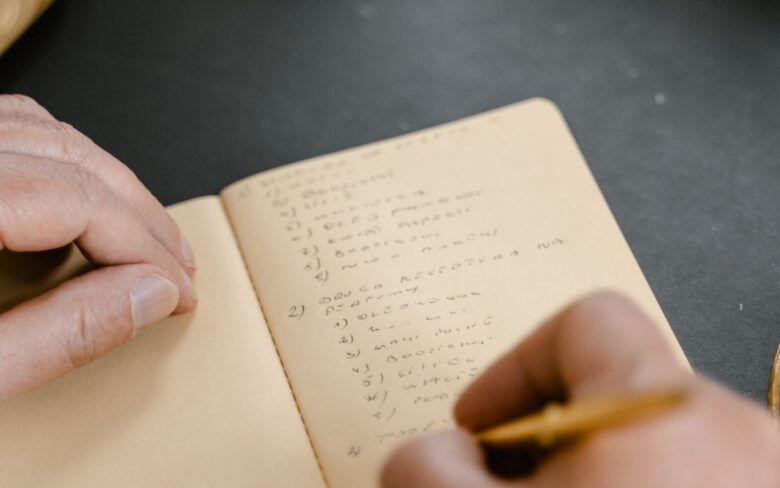
The list of pros and cons is on its fifth version.
The first one was on a napkin. The second, in the notes app on your phone. The third was an email you sent yourself on a Sunday night. The current one is on a sheet of paper folded in four, tucked into your wallet, the creases worn soft from opening and closing it on the metro.
The columns shift a little every time. The result doesn’t: a tie.
It might be taking that job or staying where you are. Leaving the relationship or giving it another chance. Moving or not. Staying in Barcelona or going back home. The question changes from one life to the next, but the feeling is much the same: something has been put on hold, and it neither starts nor switches off.
Meanwhile, the deadline to give an answer is getting closer. Or worse: nobody gave you a deadline at all, and the question can move in with you for as long as it likes.
Three months of “thinking it over”
When someone asks you what’s going on, you almost never say “I don’t know what to do.” You say something more uncomfortable: “I can’t make a decision, and I’m no longer sure whether the problem is the decision or me.”
Then comes a flawless presentation of both options. Pros, risks, what each friend said, something you half-read in an article. You know your dilemma better than anyone. You call it “thinking it over,” and you’ve been thinking it over for three months.
That’s the first clue: information is the one thing you have plenty of.
Choosing means saying goodbye to something
When a decision stalls for weeks, it’s rarely because a piece of information is missing. What holds you back, in many cases, isn’t what you stand to gain but what you stand to lose.
Choosing one path means giving up the other. And you don’t just give up an option: you give up the person you would have been if you’d taken it. The one who dared. The one who stayed. The one who went back and found everything more or less where it was.
As long as you don’t decide, both versions stay alive. Neither has been lost yet. Maybe that’s why indecision, which feels like torment, is also a kind of shelter: while it lasts, you don’t have to say goodbye to anything.
The trouble is that not deciding is also a decision. It’s just made by time, or by the other person, or by circumstances. And it tends to be the one you like least, because on top of everything it isn’t yours.
Those of us who live far from where we were born know one version of this that never quite closes: do I stay or do I go back? You answer it one year and it returns the next, at a birthday over video call or in an airport queue. I’ve had it on the table more than once myself, and I know it doesn’t get settled by adding another column.
When doubt stops being useful
Not all doubt is a problem. There’s a kind of doubt that helps: it asks you for something specific. A fact you don’t have, a conversation you haven’t had yet, a visit to the place before you move. Once you get it, the doubt shrinks or changes shape.
And there’s another kind that asks for nothing. It keeps coming back to the same point, with the same arguments, at the same hour of the night. Every round leaves you a little more worn down and exactly where you started. That doubt is no longer informing you: it’s protecting you from something. From getting it wrong, from letting someone down or, quite simply, from losing.
In many cases, people who freeze in front of a decision learned early on that mistakes were expensive. That an error was paid for with a punishment, with a long silence at the dinner table, with the feeling of having disappointed someone who mattered. If this rings a bell, the real question may not be “which option is right” but “what happens if I get it wrong.” And that question sometimes comes from long before this decision.
A few ways to get unstuck
I owe you the formula for deciding well: if anyone has it, they haven’t passed it on to me. What I can offer are a few questions that tend to move things more than the sixth version of the list:
- Put a date on the decision, not on the list. “On the 15th I decide, even if I’m not sure.” Certainty almost never arrives before you choose; it usually turns up afterwards, on foot.
- Ask yourself what you’d be saying goodbye to. Not what you gain with each option: what you lose. That’s almost always where the knot is.
- Live one day as if you’d already chosen. A whole day as if you’d said yes, and the next as if you’d said no. Notice how you wake up each morning: relieved, heavy, eager. The body often answers before the head does.
- Separate what can be undone from what can’t. Many decisions that feel final can be corrected, reversed or made again in a year’s time. If that’s the case, less is at stake than it seems.
- Look for a good-enough option, not the “right” one. The perfect option only exists as long as you don’t choose.
- If you’ve already asked ten people, stop asking. Past a certain point, each new opinion doesn’t help you decide: it helps you put it off.
None of these questions decides for you. What they do is hand the decision back to you, which is where it belongs.
If it happens with everything
With work, with your partner, with the country, and with where to eat on Saturday night. You let others choose even the small things, you struggle to know what you want when nobody asks, and when you finally choose, you spend weeks checking whether you got it right. At that point, indecision is no longer about one particular issue: it’s about how you move through life.
That’s when it’s worth looking less at the decision of the moment and more at what’s at stake for you every time you have to choose. In Gestalt therapy the right option is still yours to find; what we look at together is what happens to you at the moment of choosing. What shows up in your body when one of the two starts to win. Who’s in your head while you decide. Who would say “I told you so” if you got it wrong.
And sometimes you don’t need to start therapy at all. If what’s in front of you is a single crossroads, one with a name, there’s a format designed precisely for that: a single two-hour meeting to look at one specific matter without opening up your whole life. It’s called One Thing, One Afternoon.
Chances are both columns on that sheet are telling the truth. That’s the problem, and also the way out: there’s no option without loss waiting for you to find it.
Maybe what’s missing isn’t another column but something that fits in neither: permission to lose something, knowing that whichever path you take will have its own list of things that didn’t happen.
Some decisions are made with a clear head and others are made afraid, all the same. The second kind count too. How many of the decisions you’re grateful for today did you make feeling sure?
One day you’ll find that sheet at the bottom of a pocket, creases worn soft, and you’ll struggle to remember why it weighed so much.
This piece has a close relative: I start things and never finish them, which looks at the other side, when you’ve already chosen and the hard part is staying. And if the doubt comes with a head that never switches off, I Can’t Stop Overthinking Everything goes there.
I see people at my practice on Plaça d’Urquinaona in Barcelona, and online too, in English or Spanish. My schedule is open: if you’d like to know which times I have available, write to me.